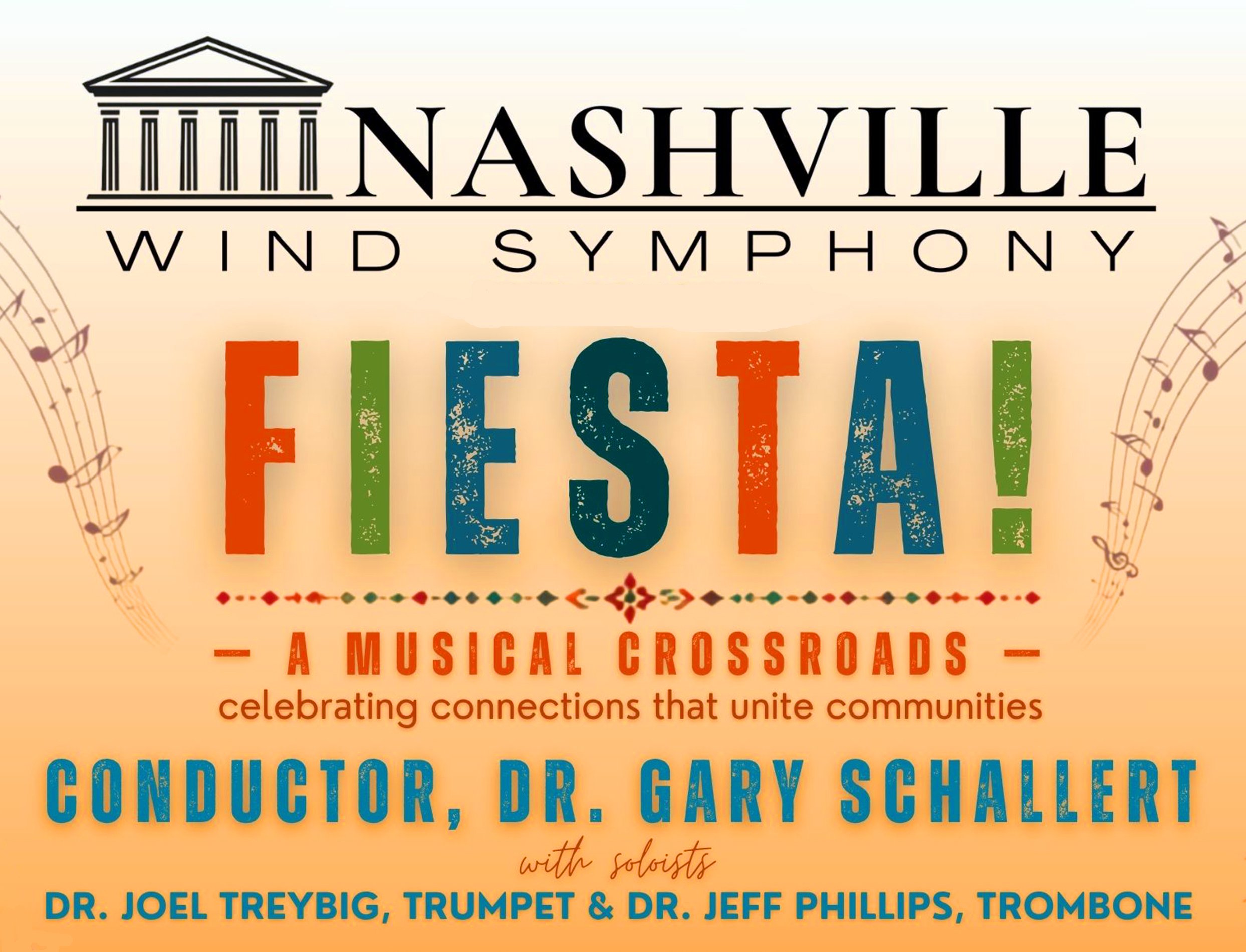
NASHVILLE WIND SYMPHONY
FIESTA!
Sunday, September 13, 2026
4:00 PM
DR. GARY SCHALLERT, CONDUCTOR
PROGRAM NOTES
El Camino Real: A Latin Fantasy
Fandango
Dr, Joel Treybig, trumpet soloist
Dr, Jeffrey Phillips, trombone soloist
La Cumparsita
La Oreja de Oro (The Golden Ear)
Beguine for Band
Santa Fe Saga
Danzas Cubanas
The Nashville Wind Symphony extends our utmost gratitude to the administration of the Franklin Special District and Performing Arts Center for their generosity in making their facility available to the Nashville Wind Symphony for today’s performance.
Additionally, this concert is made possible by Shane Kimbro and Julia Culp, Freedom Middle School band and orchestra directors, by allowing us the use of their school's percussion equipment.
El Camino Real: A Latin Fantasy (1985)
Alfred Reed (1921-2005)
~7 minutes
El Camino Real (literally "The Royal Road" or "The King's Highway") was commissioned by, and is dedicated to, the 581st Air Force Band (AFRES) and its commander, Lt. Col. Ray E. Toler. Composed during the latter half of 1984 and completed in early '85, it bears the subtitle "A Latin Fantasy."
The music is based on a series of chord progressions common to countless generations of Spanish flamenco (and other) guitarists, whose fiery style and brilliant playing have captivated millions of music lovers throughout the world. These progressions and the resulting key relationships have become practically synonymous with what we feel to be the true Spanish idiom. Together with the folk melodies they have underscored, in part derived by a procedure known to musicians as the "melodizing of harmony," they have created a vast body of what most people would consider authentic Spanish music.
The first section of the music is based upon the dance form known as the Jota, while the second, contrasting section is derived from the Fandango, but here altered considerably in both time and tempo from its usual form. Overall, the music follows a tradition three-part pattern: fast-slow-fast.
The first public performance of El Camino Real took place on April 15th, 1985, in Sarasota, Florida, with the 581st Air Force Band under the direction of Lt. Col. Ray E. Toler.
- Program Note by composer
Fandango (1999)
Joseph Turrin (b. 1947)
~ 6 minutes
Fandango was written on commission in 2000 for the University of New Mexico Wind Symphony for Philip Smith and Joseph Alessi, this six-minute piece explores the rhythmic, melodic and syncopated elements of the Spanish fandango dance form (a lively dance in triple time for two dancers).
The work divides itself into three sections: The first is a combination of lively melodic and articulated interplay between the trumpet, trombone and wind symphony. There is a stately chorale in the woodwinds that opens section two. The trombone adds itself to this material, culminating in a short cadenza leading into the third section. Section three is a basic recap of the opening material, but this time the soloists work the themes into a canon. There is a brief return of the chorale, this time for full ensemble, and then a fast coda reiterating the work's various rhythmic elements.
- Program Note by composer
La Cumparsita (1916)
Gerardo Matos Rodriguez (1897-1948)
Arranged by Miguel Etchegoncelay (2020)
Performance time: ~ 4:30
Few pieces of tango music are as instantly recognizable as La Cumparsita. Composed in 1916 by Uruguayan musician Gerardo Matos Rodríguez, the piece has become one of the most famous tangos in the world.
The title La Cumparsita can be translated as “the little parade.” The music was originally written as an instrumental march and was first performed publicly at the Café La Giralda in Montevideo. It was later transformed into a tango and lyrics written by Matos Rodriquez were added, helping propel the piece to international fame.
At the heart of the music is the distinctive character of the tango: dramatic accents, infectious rhythms, expressive melodies, and a constant sense of tension and release. La Cumparsita balances elegance with intensity, allowing the melody to move between moments of graceful lyricism and passages of unmistakable rhythmic drive.
Miguel Etchegoncelay, an Argentine arranger, brings this iconic tango into the concert-band repertoire, preserving its unmistakable personality while taking advantage of the wide range of colors and textures available in the wind ensemble.
More than a century after its composition, La Cumparsita remains a musical symbol of the tango tradition. Its memorable melody and unmistakable rhythmic character continue to make it a favorite with performers and audiences around the world. While Rodriquez composed for the theatre, as well as many other tangos, he will mainly be remembered as the composer of the tango La Cumparsita.
La Oraja de Oro (19350
(The Golden Ear)
Mariano San Miguel (1879-1935)
edited by Frederick Fennell (1984)
~ 4 minutes
Mariano San Miguel was a Spanish organist, organ maker and composer. In his later years he was the conductor of an important military band. His "symphonic" pasodoble La Oreja de Oro (The Golden Ear) is a classic adaptation of that popular dance to an extended and developed work in this form for the repertory of the band. By definition the pasodoble is a double-step, but it is known in social dancing as a one-step which became popular in the early 1920s.
San Miguel calls his a "pasodoble torero," and while its spirit does not always invoke the excitement of the crowd at a bull ring on a bright sunny afternoon, there are flashes of that awesome duel between man and animal. And there is, as well, a reflective character in the music provided by the cadenza-like material for the solo trumpet with its spurts of brilliance countered by quiet response. The triumphant concluding strains for the brass continue to unfold the "cadenza" material and include the many idioms of Spanish popular music which have been present since the opening measures.
San Miguel left no clear explanation for his title; its interpretation ranges from homage, to an ear of corn, to that of a vanquished bull. There is no doubt, however, that La Oreja de Oro is a classic, an unusual piece of Spanish popular music.
- Program Note by Frederick Fennell
Beguine For Band (1954)
Glenn Osser (1914-2014)
~4 minutes
The beguine is a dance and musical style that originated in the French Caribbean, particularly the islands of Martinique and Guadeloupe. Reflecting the Caribbean rhythmic traditions of bolero and rumba with influences from European and Latin American music, the beguine became widely familiar to American audiences through Cole Porter’s Begin the Beguine, written for “Jubilee”, a 1935 musical comedy, that spawned hit recordings by Artie Shaw and Ella Fitzgerald.
Glenn Osser’s Beguine for Band, composed in 1954, brought this distinctive rhythmic style into the concert-band repertoire. The work combines the graceful, flowing character of the beguine with colorful orchestration and the varied sonorities of the wind ensemble. Melodic material is passed among the sections of the band, while percussion and accompanying figures maintain the characteristic rhythmic foundation.
Osser was a versatile American musician whose career encompassed composition, arranging, conducting, and orchestral performance. He worked extensively in radio and television and was particularly well known for his arrangements and conducting in the world of popular music. He served as musical director for the Miss America Pageant beginning in 1955 and continued in that role for many years.
Beguine for Band reflects Osser’s ability to combine the rhythmic appeal of popular music with the rich instrumental possibilities of the concert band. Its graceful melodies, distinctive rhythm, and vibrant ensemble writing make it an engaging example of mid-twentieth-century American wind-band repertoire.
Santa Fe Saga (1956)
Morton Gould (1913-1996)
~ 10 minutes
Morton Gould’s Santa Fe Saga is a colorful musical portrait of the American Southwest. Composed in 1956 at the request of legendary bandmaster Edwin Franko Goldman for the American Bandmasters Association convention in Santa Fe, New Mexico, the work reflects the distinctive blend of Spanish, Mexican, and Western American influences associated with the region.
Rather than presenting a literal narrative, Gould creates a series of musical impressions. The work is organized into four contrasting sections, performed without pause: “Rio Grande,” “Round-up,” “Wagon Train,” and “Fiesta.”
“Rio Grande” opens with a quiet, pastoral atmosphere, suggesting the broad landscape and flowing waters of the Southwest. The peaceful mood gives way to the energetic “Round-up,” where vigorous rhythms and bold orchestration evoke the activity and excitement of cowboy life. “Wagon Train” follows with music that suggests the movement of nineteenth-century settlers across the rugged terrain, including colorful imitations of wagon wheels, whips, and jingling harnesses.
The final section, “Fiesta,” brings the work to a brilliant and celebratory conclusion. Here Gould combines the rhythmic vitality and orchestral color heard throughout the work in a spirited musical celebration of Santa Fe and its cultural heritage.
Gould was one of America's most versatile composers, equally comfortable writing for the concert hall, theater, radio, television, and popular music. His music frequently incorporated distinctly American elements, including jazz, folk music, popular dance styles, and traditional concert music. Santa Fe Saga demonstrates his particular gift for transforming these influences into vivid and accessible concert music.
Danzas Cubanas, op. 141 (2010)
Robert Sheldon (b. 1954)
~ 5 minutes
Robert Sheldon’s Danzas Cubanas celebrates the rhythmic vitality, melodic character, and infectious energy of Afro-Cuban music. Composed in 2010 for the Palm Beach County Honor Band in Boca Raton, Florida, the work was dedicated to the memory of Ubaldo Montesino, a longtime friend of Sheldon and a respected band director and trumpet player in Palm Beach County.
Danzas Cubanas explores three distinct styles of Cuban music. The work opens with a lively conga, establishing the rhythmic foundation and immediately introducing the colorful percussion sounds associated with Latin music. A more relaxed and lyrical son-salsa follows, providing a contrasting middle section before the music builds toward a fiery mambo finale.
Sheldon incorporates a wide variety of percussion instruments, including congas, bongos, claves, maracas, cowbell, güiro, and other Latin percussion, to create an authentic rhythmic character. These rhythms are combined with the rich colors of the concert band and featured solo passages for piano, trombone, flute, and trumpet.
The composer has noted that, although much Cuban music is strongly rhythm-driven, he considers himself “a melody guy” and deliberately gave Danzas Cubanas a more melodic character. The result is a work in which infectious rhythms and memorable melodies work together throughout.
From its opening conga to its energetic mambo conclusion, Danzas Cubanas invites performers and listerners alike to relish important Cuban musical traditions. Its combination of rhythm, melody, percussion, and instrumental color makes it a vibrant celebration of the musical culture of Cuba, and a fitting conclusion to this evening’s FIESTA!
BIOGRAPHY
DR. GARY SCHALLERT, CONDUCTOR
Dr. Gary Schallert is Director of Bands and Professor of Music at Western Kentucky University where he administrates the band program, conducts the Wind Ensemble and Symphonic Band, and teaches graduate and undergraduate courses in conducting and music education. Additionally, he supervises instrumental student teachers. Prior to his appointment at WKU, he served on the faculty at Belmont University, the University of Missouri, and the University of Tennessee, and also taught in the Albuquerque and Las Cruces, New Mexico public schools.
Schallert earned his Bachelor of Music Education and Master of Music degrees from New Mexico State University, and the Doctor of Arts degree in Wind Conducting from the University of Northern Colorado under the mentorship of Ken Singleton and Richard Mayne. Schallert maintains an active schedule as a guest conductor and clinician throughout the United States and has conducted touring ensembles in Europe, Australia, and Costa Rica. Under his leadership, the WKU Wind Ensemble performed at the 2012, 2016, 2020, and 2024 KMEA Conferences and the 2016 CBDNA Southern Division Conference in Charleston, SC. A champion of new music for wind band, Schallert has led or participated in more than 35 commissioning projects. He has contributed Teacher Resources Guides for ten volumes of the popular series Teaching Music Through Performance in Band.
Dr. Schallert was elected to the prestigious American Bandmaster Association and is also a member of the Kentucky Music Educators Association, which honored him with the College/University Teacher of the Year Award in 2017. Other professional affiliations include the College Band Director's National Association, the National Association for Music Education, the National Band Association, and the KMEA Third District Band Director Association. He is a member of Phi Beta Mu, Phi Mu Alpha, and is an honorary member of Kappa Kappa Psi and Tau Beta Sigma. He and his wife, Amy, reside in Bowling Green and have four sons and a foster daughter; Ryan, Casey, Evan, Trevor, and Julia.
PERSONNEL
FLUTE
Tawana Box, Private Instructor
Natalie Gregg Bracey, Private Music Instructor
Beth Davis, Band Director & Music Educator
Carole Smith Grooms, Band & Orchestra Director (Ret.)
Ellen Vinocur Potash, Instrumental Music Teacher (Ret)
Renee Renaud, Elementary Music Teacher
Anne Roloff, Assistant Superintendent & NU Professor (Ret.)
OBOE
Julia Culp, Band & Orchestra Director
Evabeth Ellis, Lifelong Learner
OBOE & ENGLISH HORN
Amanda Rebstock, Oboe Teacher
BASSOON
Harold Skelton, Mechanical Engineer (Ret.)
Gary Wilkes, Band & Orchestra Director (Ret.)
CLARINET
Nick Blue, Band Director
Simon Biddle, U. S. Marine Corps Musician
Mark Dortwegt, Band Director
Sherie Grossman, Music Educator
Jacob Hickman, Freelance Musician
Phillip Kigaita, Band Director
Cindy Morelli, Lessons, Gigs (Ret)
Breanne Osborne, Nurse Practitioner
River Stoltz, Band Director
Laura Verdone, Band Director (Ret)
Nayana Wexler, Sony Music Publishing
Elizabeth Wiles, Band Director
Chrystal Womack, Healthcare VUMC & YMCA
E-FLAT CLARINET
Cindy Morelli, Lessons, Gigs (Ret)
BASS CLARINET
Randal Box, Band Director (Ret)
Lee Johnson, Sony Music Publishing
CONTRA-ALTO CLARINET
Nathan Davis, Band Director
ALTO SAXOPHONE
Jessica Graves, Director of Bands
Ed Grooms, Project Management Director, Consociate Health
Erin Heiselman, Band Director
Michael Roland, Supply Chain IT
TENOR SAXOPHONE
Gary E Merritts, Band Director (Ret)
Lisa Northcutt, Band staff, Private instructor
BARITONE SAXOPHONE
Phillip Church, Church Pastor & Band Director
TRUMPET
Ben Channell, Band Director
Katie Harrah, Real Estate Agent
Shane Kimbro, Band Director
Sam Litt, University Professor of Music
Kate Marcino, Trumpet Educator
Wendy Matthews, University Professor of Music
Mondale Rogers, Band & Orchestra Director
Bek Schmidt, Administrative Assistant
Alan Suska, Freelance Trumpet / Educator
FRENCH HORN
Jacob Campbell, Band Instrument Repair Technician
Andrew Esch, Military Band Conductor (Ret)
Sarah Harris, TX Band Director (Ret)
Andrew Lawson, Band Director
Chris Moth, Software Developer
Allison Rau, Musician, Concord Music Publishing
Robyn Ryan, Attorney (Ret.)
Will Smith, Band Director
TROMBONE
Rick Blake, Software Developer
Reggie Coleman, Band Director
Jonathan Hooper, Conductor, Tarleton State University (Ret.)
Charles Jenkins, Insurance Professional
Todd Shipley, Nonprofit Program Director
Eric Wenker, Ford Credit (Ret.)
EUPHONIUM
Carroll Gotcher, Band Director
Capper Howard, Low Brass Instructor
Josh Morton, Financial Advisor
TUBA
Mark Judd, Band Director
Daniel Perez, Elementary Music Teacher
Vic Stephens, TN Dept of Labor
Chris Warpool, Music Educator
DOUBLE BASS
Sean Greene, Music Educator
PERCUSSION
Leslie Church, Teacher
Hanna Dortwegt, Band Director
Isaac Loy, Percussion Educator / Clinician
Nicholas Ryan, Biologist/Chemist
Mason Sowder, Music Educator
Colby Savary, Freelance Composer/Arranger
PIANO
Evan Burton, Band Director
ACKNOWLEDGEMENTS
This concert is made possible in part by our corporate sponsors:
Fort Worth Diagnostics
Podium Sponsor
Ashley McBryde’s Light On Fund of Music Community Foundation
Repertoire Sponsor
as well as our
Bronze, Silver, Gold and Platinum Supporters
and Friends of NWS,
The Nashville Wind Symphony extends our utmost gratitude to the administration of the Franklin Special District and Performing Arts Center for their generosity in making their facility available to the Nashville Wind Symphony for today’s performance.
Additionally, this concert is supported by Shane Kimbro and Julia Culp, Freedom Middle School band and orchestra directors, by allowing us the use of their school's percussion equipment this evening.
The Nashville Wind Symphony is profoundly grateful to the David Lipscomb University School of Music for its steadfast support of adult music-making, generously providing rehearsal facilities as well as essential equipment and logistical assistance for this concert.
The Nashville Wind Symphony sincerely thanks Wes Ramsay, Representative of the Associated Board of the Royal Schools of Music, for generously underwriting concert flyers and tonight’s printed program.
Learn more about how you can support
the Nashville Wind Symphony here.
Nashville Wind Symphony Board of Directors
Carole Grooms, President
Alan Suska, Secretary
Laura Verdone, Treasurer
Phillip Church, Operations Director
Carroll Gotcher, Communications Director
Beth Davis, Personnel Manager
Ben Channell, Equipment Manager
Jonathan Hooper, Member Advisory
Harley Tatarsky, Member Advisory