
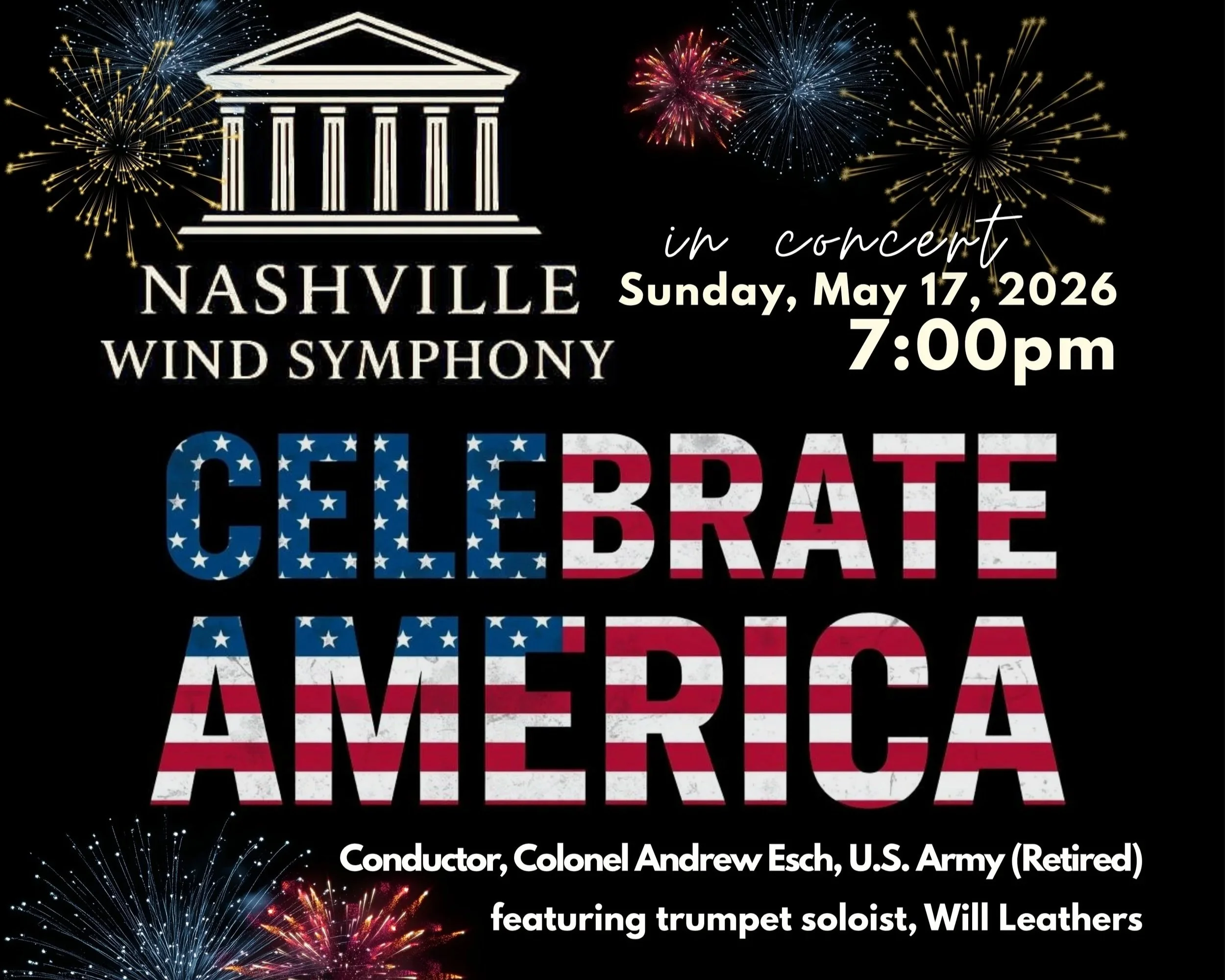
NASHVILLE WIND SYMPHONY
“CELEBRATE AMERICA!”
Sunday, May 17, 2026
7:00 PM
COLONEL ANDREW ESCH, CONDUCTOR
WILL LEATHERS,PRINCIPAL TRUMPET
Nashville Symphony Orchestra
PROGRAM NOTES
Jubilee Overture
A Hymn to New England
Easter Monday on the White House Lawn
Shenandoah
Three Dance Episodes
from “On The Town”
With Malice Toward None
Will Leathers, Trumpet
Armed Forces Salute
Festival Overture
on the American National Air
“The Star-Spngled Banner”
The Nashville Wind Symphony wishes to thank Martin Luther King, Jr. Magnet School, Angela McShepard-Ray, Principal, and John Womack and Noah Morgan, Band Directors, for hosting tonight’s concert.
Jubilee Overture (1983)
Philip Sparke (b. 1951)
~7 minutes
Originally published for brass bands as Golden Jubilee, Sparke adapted the work for wind band in 1989 and in that form, it has become one of his most performed concert openers.
The celebratory title is depicted from the outset in the majestic opening fanfare followed by an energetic allegro filled with rhythmic vitality and dazzling orchestration. Sparke’s masterful scoring for brass is balanced throughout the work by expressive melodic passages that showcase the diversity of textures available to the modern wind ensemble. A graceful moment of warmth and reflection is provided by a flowing central section before the music races to a triumphant conclusion.
Combining brass band tradition with the vivid colors possible in the symphonic wind ensemble, Jubilee Overture is acclaimed by audiences and performers alike for its energy, skillful composition, and festive atmosphere.
A Hymn to New England (1987)
John Williams (b. 1932)
Adapted for wind band by Paul Lavendar (2000)
~ 3 minutes
A Hymn to New England, composed by John Williams in 1987 for the Boston Pops Orchestra and adapted for concert band by Paul Lavendar, reveals a more intimate, contemplative side of John Williams. Known for composing some of the most iconic film scores in cinematic history, Williams approaches this work as a tribute to the spirit and character of New England, evoking the region’s quiet beauty, deep-rooted traditions, and enduring sense of community.
Beginning with unison trumpets and building into a full ensemble fanfare, the work is ultimately based on a noble chorale melody. Developing with warmth and restraint, its simple yet expressive themes are allowed to resonate naturally, the masterful orchestration bringing a richness and depth to the music without affecting its sincerity. The hymn-like nature is both reverent and nostalgic, and brings to mind the landscapes, churches, and town greens that have long spoken to New England’s cultural heritage.
Although A Hymn to New England is modest in scale compared to many of Williams’ epic symphonic works, it carries a profound emotional weight, combining both the chorale theme and the fanfares into the powerful conclusion.
Easter Monday on the White House Lawn (1928)
John Philip Sousa (1854-1932)
Arranged by R. Mark Rogers (2000)
Performance time: ~3 minutes
According to some historians, First Lady Dolly Madison originated the idea of a public Easter-egg roll in Washington D.C. as early as 1816. Others tell stories of informal egg-rolling parties at the White House as early as President Lincoln’s administration. Beginning in the 1870s, people from all social levels from Washinton D.C. celebrated Easter Monday on the west grounds of the U.S. Capitol, with children rolling brightly dyed hard-boiled eggs down the lawn’s manicured terraces.
By 1876 concerns about landscape damage led Congress to pass a law restricting use of the Capitol grounds, prohibiting the practice of egg-rolling. The new law wasn’t an issue in 1877 as rain cancelled all Easter Monday activities, but in 1878 President Rutherford B. Hayes invited children to move their egg-rolling to South Lawn of the White House, up to then reserved for the First Family’s private Easter activities, and a new tradition was born, soon to include music provided by the Marine Band.
In 1918 Sousa composed a new finale for his suite “Tales of a Traveler” - Easter Monday on the White House Lawn. The upbeat ragtime nature, lighter and more playful in nature than many of his marches, captures the energy of America of the roaring twenties.
This arrangement by R. Mark Rogers preserves Sousa’s charm and elegance while adapting the score for modern concert band performance, resulting in an enchanting example of Sousa’s ability to combine patriotic style with droll warmth and unmistakable American spirit.
Shenandoah (2019)
Traditional, Arranged by Omar Thomas
Composed: 2019
~ 8 minutes
Shenandoah is one of the most well-known and beloved Americana folk songs. Originally a river song detailing the lives and journeys of fur traders canoeing down the Missouri River, the symbolism of this culturally significant melody has been expanded to include its geographic namesake -- an area of the eastern United States that encompasses West Virginia and a good portion of the western part of Virginia -- and various parks, rivers, counties, and academic institutions found within.
Back in May of 2018, after hearing a really lovely duo arrangement of Shenandoah while adjudicating a music competition in Minneapolis, I asked myself, after hearing so many versions of this iconic and historic song, how would I set it differently? I thought about it and thought about it and thought about it, and before I realized it, I had composed and assembled just about all of this arrangement in my head by assigning bass notes to the melody and filling in the harmony in my head afterwards. I would intermittently check myself on the piano to make sure what I was imagining worked and ended up changing almost nothing at all from what I’d heard in my mind’s ear.
This arrangement recalls the beauty of Shenandoah Valley, not bathed in golden sunlight, but blanketed by low-hanging clouds and experiencing intermittent periods of heavy rainfall (created with a combination of percussion textures, generated both on instruments and from the body). There are a few musical moments where the sun attempts to pierce through the clouds, but ultimately the rains win out. This arrangement of Shenandoah is at times mysterious, somewhat ominous, constantly introspective, and deeply soulful.
- Program Note by composer
Three Dance Episodes from “On The Town” (1944)
Leonard Bernstein (1918-1990)
Arranged by Paul Lavendar
~10 minutes
Leonard Bernstein’s On the Town premiered on Broadway in 1944 and marked not only the composer’s first venture into musical theater and the Broadway stage, but also his first major theatrical success.
Based on the composer’s ballet Fancy Free, the musical tells the story of three sailors on a 24-hour shore leave in New York City during World War II. Bursting with exuberance, romance, humor, and Manhattan’s relentless pace, the show showcased Bernstein’s distinctive voice—a lively fusion of classical technique, jazz, swing, and American popular music.
It seems only natural that dance should play a leading role in the show On The Town, since the idea of writing it arose from the success of the ballet Fancy Free. I believe this is the first Broadway show ever to have as many as seven or eight dance episodes in the space of two acts; and, as a result, the essence of the whole production is contained in these dances. I have selected three of them for use as a concert suite:
Dance of the Great Lover (from the Dream Ballet, Act 2)
Pas de Deux (from the “Lonely Town” Ballet, Act 1)
Times Square Ballet (Finale, Act 1)
That these are, in their way, symphonic pieces rarely occurs to the audience actually attending the show…
-- Program notes by the composer
These three selections capture some of the score’s most exciting musical moments in a concise and brilliantly crafted concert setting. Lavender’s arrangement brings Bernstein’s rhythmic drive, harmonic color, and captivating melodies into a skillful adaptation for wind band that maintains the theatrical excitement and urban sophistication of the original work.
The suite moves through a variety of moods and styles, from bustling, jazz-infused dance to sweeping lyrical passages, quiet, introspective emotion and exuberant finales. Syncopated brass figures, sparkling percussion, and energetic woodwind lines brilliantly evoke the pulse of New York City and the youthful spirit of the sailors on leave. At the same time, Bernstein’s gift for melody brings warmth and emotional depth to the music.
More than a simple Broadway arrangement, Three Dance Episodes from On the Town shows Bernstein’s gift for bridging concert music and musical theater in a score that is both sophisticated and immediately appealing.
With Malice Toward None (2012)
John Williams (b. 1932)
Arranged by Paul Lavender
~ 4 minutes
With Malice Toward None was composed by John Williams for Steven Spielberg’s film Lincoln, which earned Williams the Academy Award for Best Original Score. The film portrays the 16th President of the United States as he confronts the Civil War’s consequences both politically and personally.
This selection, regarded by critics as the noble and sentimental heart of the film, takes its title from President Abraham Lincoln’s Second Inaugural Address: “With malice toward none, with charity for all.” The simple, lyrical, folksong-like melody conveys the dignity, humanity, and quiet strength associated with Lincoln during one of the most turbulent periods in American history.
Unlike the epic adventure themes for which Williams is widely known, this work is markedly restrained and deeply introspective. The music carries a sense of contemplation and compassion, evoking both the heavy burden of leadership and Lincoln’s unrelenting hope for reconciliation at the close of the war.
With Malice Toward None stands as a poignant example of Williams’ ability to render profound emotion through subtlety and simplicity, offering a moving musical portrait of one of America’s most revered leaders.
Armed Forces Salute
Arranged by Michael Brown, Paul Murtha & Sara Corry
~ 4 minutes
Armed Forces Salute is a patriotic tribute honoring the men and women who have served, and are serving, in the United States Armed Forces. This collaborative arrangement by Michael Brown, Paul Murtha, and Sara Corry presents the official songs of the military branches in a continuous and ceremonial medley, celebrating the tradition, pride, and service associated with each branch.
The arrangement begins with “Semper Paratus,” the official song of the U.S. Coast Guard, followed by “Semper Supra” for the U.S. Space Force, “The U.S. Air Force,” “The Marines’ Hymn,” “Anchors Aweigh,” and concludes with “The Army Goes Rolling Along.”
In many performances, as we will this evening, veterans, active-duty personnel, and family members are invited to stand during the song representing “their” branch, transforming the work into both a musical performance and a public expression of gratitude.
Festival Overture on the American National Air (1879)
“The Star-Spangled Banner”
Dudley Buck (1839–1909)
Arranged by Dwayne Milburn
~ 7 minutes
Dudley Buck was one of the leading American composers and organists of the late nineteenth century, and although he is less well-known than many of his contemporaries, in his day he was widely regarded for his efforts to establish a distinctly American voice in concert music. Composed in 1879 for an Independence Day festival, Festival Overture on the American National Air is among Buck’s most patriotic and celebratory works, written during a period of growing national identity and artistic development in the United States. The Air referenced in the title is, of course, known now as The Star-Spangled Banner.
It must be noted that the Air was not officially the National Anthem; the United States did not have an official anthem as yet. Francis Scott Key wrote the poem Defence of Fort McHenry, later to be renamed The Star-Spangled Banner, specifically to fit a well-known tune of the day, To Anacreon In Heaven, written by John Stafford Smith for a popular London gentlemen’s club of amateur musicians. Increasing in popularity throughout the 19th century, there was a widespread movement in the nation that “The Star-Spangled Banner” should be officially named the National Anthem of the United States of America. In 1916, President Woodrow Wilson signed an order that the Star-Spangled Banner by played on official occasions, and on March 3, 1931, President Herbert Hoover signed a congressional act officially adopting it as the national anthem.
Buck uses the Air as the foundation for an expansive and exuberant concert overture. Rather than presenting the melody directly throughout, Buck develops fragments of the anthem through a variety of instrumental textures, contrapuntal passages, and dramatic contrasts. The work opens with grandeur and ceremony and is developed through energetic and lyrical episodes that gradually build toward splendid statements of the familiar patriotic tune.
The overture reveals both European Romantic influences and American patriotic spirit, combining rich harmonies, broad, scenic melodies, and brilliant fanfares. The result is a work that is both complex in construction and immediately accessible in its emotional impact.
Festival Overture on the American National Air stands as an early example of American symphonic patriotism, glorifying national pride while demonstrating the growing maturity of American concert music in the late nineteenth century.
BIOGRAPHIES
COLONEL ANDREW J. ESCH, CONDUCTOR
Colonel Andrew J. Esch is an internationally recognized symphonic band conductor, most recently serving as the 11th Director of The United States Army Band, “Pershing’s Own,” in Washington DC, the nation’s largest and most dynamic military band. Colonel Esch also served as the 24th Director of the U.S. Military Academy Band at West Point, Director of the U.S. Army Band and Chorus in Heidelberg, Germany, and Dean of the U.S Army School of Music. His ensembles have been featured at the Midwest Clinic in Chicago, Texas Bandmasters Association, and the American Bandmasters Association national conference as well on NBC’s Today Show, Fox & Friends, and CBS’s Good Morning America.
Across his musical career, Colonel Esch represented the nation at prestigious venues across the United States and Europe, including Paris, London, Basel, Heidelberg, Sophia, Krakow, and Moscow. Colonel Esch also represented the US Army at the White House ceremony where military bands were awarded the National Medal of the Arts in 2019.
Colonel Esch holds a Bachelor of Music Education degree from Michigan State University, a Master’s degree in Conducting from George Mason University, and performed as a French Hornist with the United States Air Force Band in Washington, DC.
WILL LEATHERS, TRUMPET SOLOIST
Will Leathers earned Bachelor’s and Master’s degrees from The Juilliard School in 2022 and 2023 and was the first undergraduate classical trumpeter to receive the prestigious Kovner Fellowship. In 2022, while still completing his studies, Will secured the highly sought-after position of Principal Trumpet for both the Nashville Symphony Orchestra and the Santa Fe Opera, an extraordinary accomplishment for a musician at his stage of career. He continued to break barriers, being recognized by CBC Music as one of Canada’s “30 Hot Classical Musicians Under 30” and earning his Bachelor of Music in 2022 and his Master of Music in 2023, solidifying his place as one of his generation's most promising classical musicians.
He has performed with world-renowned ensembles, including New York Philharmonic Brass, Cleveland Orchestra, St. Louis Symphony Orchestra (Guest Principal Trumpet), Toronto Symphony Orchestra (Guest Principal Trumpet), and Philadelphia Orchestra (Guest Associate Principal Trumpet). He also performs as a concerto soloist, both on piano and trumpet.
Will’s artistry has also led him to collaborations with elite chamber ensembles, including The National Brass Ensemble, where he was invited to perform and record with some of the finest brass musicians from major American orchestras, American Brass Quintet, Rodney Marsalis Philadelphia Big Brass, and Santa Fe Chamber Music Festival Orchestra. He has been a part of a number of recordings such as "Deified", an album by the National Brass Ensemble, and soundtrack for the film Rustin Produced by Barack and Michelle Obama's production company Higher Ground.
Will is a performing artist for Bach Brass and Vennture Mouthpieces, where he is consulting on the development of a line of trumpet mouthpieces in his name.
For more about tonight’s soloist, visit willeathers.com
PERSONNEL
FLUTE
Tawana Box, Private Instructor
Natalie Gregg Bracey, Private Music Instructor
Beth Davis, Band Director & Music Educator
Carole Smith Grooms, Retired School Band & Orchestra Director
Renee Renaud, Elementary Music Teacher
Dr. Anne Roloff, Retired Assistant Superintendent & NU Professor
Sasha Walls, Data Analyst
OBOE
Julia Culp, Band & Orchestra Director
Evabeth Ellis, Lifelong Learner
Amanda Rebstock, Oboe Teacher
ENGLISH HORN
Amanda Rebstock, Oboe Teacher
BASSOON
Jared Ford, Band Director, Siegel Middle School
Harold Skelton, Mechanical Engineer (Ret.)
Gary Wilkes, Band & Orchestra Director (Ret.)
CLARINET
Nick Blue, Band Director
Dr. Jazmin Chavez, Educator
Mark Dortwedt, Band Director, Hillsboro Middle School
Sherie Grossman, Music Educator
Clayton Hamilton, Director of Instrumental Music
Phillip Kigaita, Band Director
Cindy Morelli, Lessons, Gigs (Ret)
River Stoltz, Band Director, Cameron Central HS
Laura Verdone, Band Director (Ret)
Nayana Wexler, Sony Music Publishing
Rebecca Williamson, Band Director
Chrystal Womack, Healthcare VUMC & YMCA
E-FLAT CLARINET
Myranda Uselton Shirk, Lecturer/Researcher of Data Science
BASS CLARINET
Randal Box, Band Director (Ret)
Jaycie LaBrec, Band Director
CONTRA-ALTO CLARINET
Nathan Davis, Band Director
ALTO SAXOPHONE
Jessica Graves, Director of Bands, Nolensville High School
Ed Grooms, Project Management Director, Consociate Health
Erin Heiselman
Michael Roland, Supply Chain IT
TENOR SAXOPHONE
Garrett Brooks, Band Director
Gary E Merritts, Band Director (Ret)
BARITONE SAXOPHONE
Phillip Church, Church Pastor & Middle School Band Director
TRUMPET
Ben Channell, Band Director
Andy Corum, Director, Brass Band of Nashville
Katie Harrah, Real Estate Agent
Mike Keeley, Church Music Director (Ret)
Barry Krause, Collegiate Band Director
Kate Marcino, Trumpet Educator
Wendy Matthews, Professor of Music, Lipscomb University
Mondale Rogers, Band & Orchestra Director
Alan Suska, Freelance Musician / Educator
FRENCH HORN
Lisa Burden, Band Director
Jacob Campbell, Band Instrument Repair Technician
Dr. Ronda DePriest, Conductor, Music Educator
Sarah Harris, TX Band Director (Ret)
Andrew Lawson, Band Director
Allison Rau, Musician, Concord Music Publishing
Robyn Ryan
Will Smith, Band Director, Mt. Juliet Middle School
TROMBONE
Reggie Coleman, Band Director
Jonathan Hooper, Conductorr (Ret) Tarleton State University
Charles Jenkins, Insurance Professional
Wesley K. Ramsay, Music Publisher
Todd Shipley, Nonprofit Program Director
Eric Wenker, Retired
EUPHONIUM
Carroll Gotcher, Music Educator
Derick Haney, Former Band Director
Josh Morton, Financial Advisor
TUBA
Mark Judd, Band Director, Fairview High School
Daniel Perez, Music Teacher
Vic Stephens, TN Dept of Labor
Chris Warpool
DOUBLE BASS
Andy Byrd
PERCUSSION
Leslie Church, Teacher
Hanna Dortwegt, Band Director
Corey Francis, Music Teacher
Isaac Loy, Percussion Educator / Clinician
Mason Sowder, Band Director
PIANO
Evan Burton, Band Director
ACKNOWLEDGEMENTS
The Nashville Wind Symphony is profoundly grateful to the David Lipscomb University School of Music for its steadfast support of adult music-making, generously providing rehearsal facilities as well as essential equipment and logistical assistance for this concert.
The Nashville Wind Symphony sincerely thanks Wes Ramsay, Representative of the Associated Board of the Royal Schools of Music, for generously underwriting concert flyers and tonight’s printed program.
As a newly formed non-profit, it will be some time before we are positioned to secure significant grant or corporate support. During this, our inaugural season, we rely on the generosity of individual donors to help underwrite both start-up costs and expenses associated with each performance.
Make your tax-deductible, online charitable contribution to support the Nashville Wind Symphony:
MAIL: Nashville Wind Symphony c/o Laura Verdone, Treasurer 3137 Windsor Green Dr. Antioch, TN 37013
ONLINE: PayPal
ZELLE: @NashvilleWindSymphony treasurer@nashvillewindsymphony.org
Nashville Wind Symphony Board of Directors
Carole Grooms, President
Alan Suska, Secretary
Laura Verdone, Treasurer
Phillip Church, Operations Director
Carroll Gotcher, Communications Director
Beth Davis, Personnel Manager
Ben Channell, Equipment Manager
Jonathan Hooper, Member Advisory
Harley Tatarsky, Member Advisory